
Talking Mynah (Gracula religiosa)
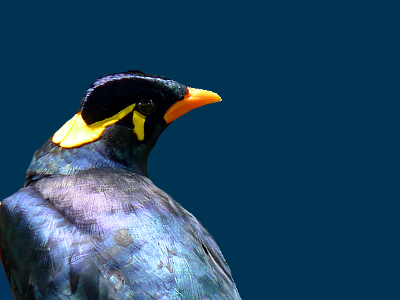 The Talking Mynah, Common Hill Mynah or locally kiyaw (Gracula religiosa) is one of the most sought birds in the Province of Palawan. It can talk even better than the well-known blue-naped parrot (Tanygnathus lucionensis).
The talking mynah can mimic not only the sound of other birds or animals but also the sound of a bicyle's horn when vendors make their daily rounds in the community to sell pan de sal (bread of salt). If you happen to visit Baker's Hill, you will be startled by an eloquent "Good morning" or "Kumain ka na ba" greeting upon peering in a sheet of plastic mesh to see the bird.
Population
The ability of the mynah to mimic a wide range of sounds caused a significant reduction of its wild population. The bird was trapped unwittingly by the locals for many years thinking it's a legitimate source of income until the government restricted its hunting as the bird's population in the wild declined.
Prohibition drove the bird's price to thousands of pesos in the black market as unscrupulous individuals still hunt the mynah for a living. Occasionally, there are reports of tens, even hundreds of caged mynah transported through less patrolled exit points in northern Palawan and the "backdoor" to Sabah.
Individuals, however, can have legal custody of the bird through a permit issued by the Department of Environment and Natural Resources (DENR) or the Palawan Council for Sustainable Development (PCSD). These birds are tagged with aluminum ring around the lower part of their legs.
The International Union for the Conservation of Nature (IUCN) categorized the mynah under Least Concern because it is believed that its current population has not reached a Vulnerable status. The species is regarded worldwide as common and abundant.[1]
Distribution
This species has a wide range of distribution because it can be found in Sri Lanka and the Western Ghats of India, east and north-east India east to southern China, and south through south-east Asia, Borneo, and Indonesia. Populations are also introduced in Puerto Rico[1].
Reference
1. BirdLife International 2012. Gracula religiosa. In: IUCN 2013. IUCN Red List of Threatened Species. Version 2013.1.